

House Passes Ban on Congressional Stock Purchases as Smith Backs Crackdown on Capitol Hill Trading
The Smith-backed bill would bar members and their families from buying stocks, hot on the heels of a South Jersey Democrat posting the second-highest portfolio gains in Congress.

WASHINGTON — The U.S. House of Representatives on Tuesday passed the Stop Insider Trading Act, legislation that would prohibit members of Congress, their spouses, and their dependent children from purchasing stock in publicly traded companies — a direct response to years of mounting evidence that lawmakers’ portfolios routinely outperform the markets they regulate.
Rep. Chris Smith (R-NJ-04), an original cosponsor of the bill, applauded the passage and urged the Senate to act quickly.
“Members cannot and should not use their public office and insider information to line their pockets,” Smith said.
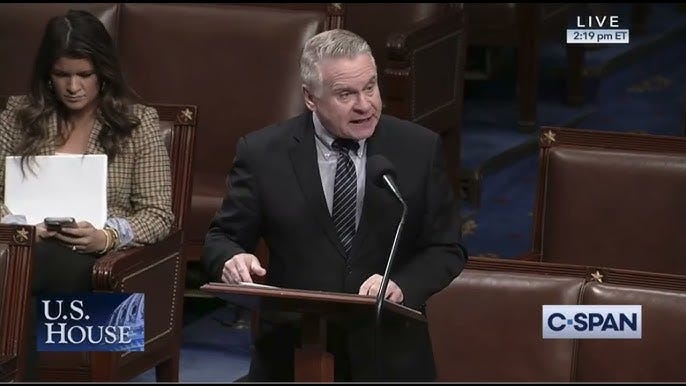
Under HR 7008, introduced in January by House Administration Committee Chairman Bryan Steil (R-WI), sitting members could no longer buy individual securities, and would be required to file a public disclosure before selling any stock they already own. Violators would face a fine of $2,000 or 10 percent of the transaction’s value — whichever is greater — plus forfeiture of any net gain from the trade.
That penalty structure is the point. Under the current law, the 2012 STOCK Act, the standard fine for a disclosure violation is $200 — and in nearly fifteen years, no member of Congress has ever been prosecuted for insider trading under it.
The Returns That Built the Pressure
The bill arrives against a backdrop of trading data that has become impossible for either party to explain away.
According to the annual Unusual Whales congressional trading report, the top ten performers in Congress all more than doubled the S&P 500’s 16.6 percent gain in 2025. Rep. Warren Davidson (R-OH) led the chamber at +78.8 percent. Directly behind him: Rep. Donald Norcross (D-NJ), whose portfolio gained 70.8 percent — the second-best performance in the entire Congress, and more than four times the market.
The list cut across party lines — six Republicans and four Democrats, including Sen. Rick Scott (R-FL) at +54.8 percent and Sen. Alex Padilla (D-CA) at +61.7 percent. A separate Common Cause analysis found members executed more than 13,300 trades totaling roughly $635 million in 2025 alone — including nearly 200 trades made by lawmakers during the government shutdown, while their constituents missed paychecks.
Then there is the perennial case study. Former Speaker Nancy Pelosi (D-CA) — whose husband Paul executes the family’s trades — beat the S&P 500 again in 2025, and her portfolio’s decade-long cumulative return of roughly 816 percent nearly triples what Warren Buffett’s Berkshire Hathaway returned over the same period. Most professional money managers cannot beat the index for a few consecutive years. Pelosi’s household has done it for over a decade — while she sat in classified briefings on the industries her family traded.
Suspicion Without Consequence
The allegations are not new. What is new is a penalty with teeth.
In 2020, multiple senators — including then-Intelligence Committee Chairman Richard Burr (R-NC), Kelly Loeffler (R-GA), David Perdue (R-GA), and Dianne Feinstein (D-CA) — sold millions in stock after closed-door COVID-19 briefings and just before the February 2020 market crash. The Justice Department opened a probe, then closed it; no charges were ever brought against anyone.
At a November House Administration hearing, witnesses cited additional cases: Senate Intelligence Chairman Tom Cotton’s (R-AR) sale of $1.6 million in stock shortly before the pandemic was announced in the United States, and the timing of Pelosi-family trades around electric-vehicle and microchip funding announcements. This spring, Sens. Mark Warner (D-VA) and Adam Schiff (D-CA) demanded an SEC investigation into surges of options activity minutes before major federal policy announcements, including the April 2025 tariff pause.
The pattern, across every case: suspicion, headlines, and no consequence. Ethics watchdogs note the STOCK Act’s enforcement record amounts to rare, nominal fines assessed through an opaque process — a system that deters nothing.
The Election Integrity Rider
The House-passed bill also carries a provision requiring prospective voters to present valid photo identification before casting a ballot in a federal election. Mail-in voters would enclose a copy of their photo ID, the last four digits of their Social Security number, and an affidavit; voters without ID at the polls could cast provisional ballots, with three days to provide documentation.
Smith called the provision especially timely, citing this week’s revelation — first reported extensively in these pages — that New Jersey’s motor vehicle registration system enrolled approximately 6,600 non-U.S. citizens to vote between June 2023 and June 2024, roughly 400 of whom went on to cast ballots.
What Comes Next
The bill now moves to the Senate, where Sen. Pete Ricketts (R-NE) introduced a companion measure in March and where President Trump’s State of the Union call for a trading ban drew a rare bipartisan standing ovation. Critics on both flanks — including Reps. Chip Roy (R-TX), Anna Paulina Luna (R-FL), and Alexandria Ocasio-Cortez (D-NY) — argue the bill doesn’t go far enough, since members may retain existing holdings rather than divest them.
But after a year in which two-thirds of Congress couldn’t beat the index while the top tier quadrupled it, the House has, for the first time, attached a real price to the trade. Whether the Senate — where several of the best-performing portfolios reside — will vote to bind itself remains the open question.
Want more CJN? Make sure to follow us on our respective social media platforms. If you’re interested in joining the team, have questions about advertising, or want to send us a note, message us here on Substack.