

Kanitra's bombshell report drops: here's how much you're spending on illegals.
Assemblyman Paul Kanitra's new report lays out what New Jersey's embrace of illegal immigration is costing New Jersey families.

Two years ago, freshman assemblyman Paul Kanitra posed an important question that few had entertained, even fleetingly: how much is illegal immigration costing us?
The next year, the May 2024 edition of Kanitra’s Report on the Cost of Illegal Aliens to New Jerseyans landed in the middle of the border crisis and stayed in circulation for months. National outlets picked it up. President Trump cited it from the stage in Wildwood that same month. Central Jersey Newswire covered the findings at the time in a three-part series — Part I, Part II and Part III — and the report’s authors were kind enough to note our coverage among the outlets that carried it.
Kanitra’s office is now out with the 2026 edition, built on federal and state data, records obtained through the Office of Legislative Services, and Open Public Records Act requests filed directly with state agencies.
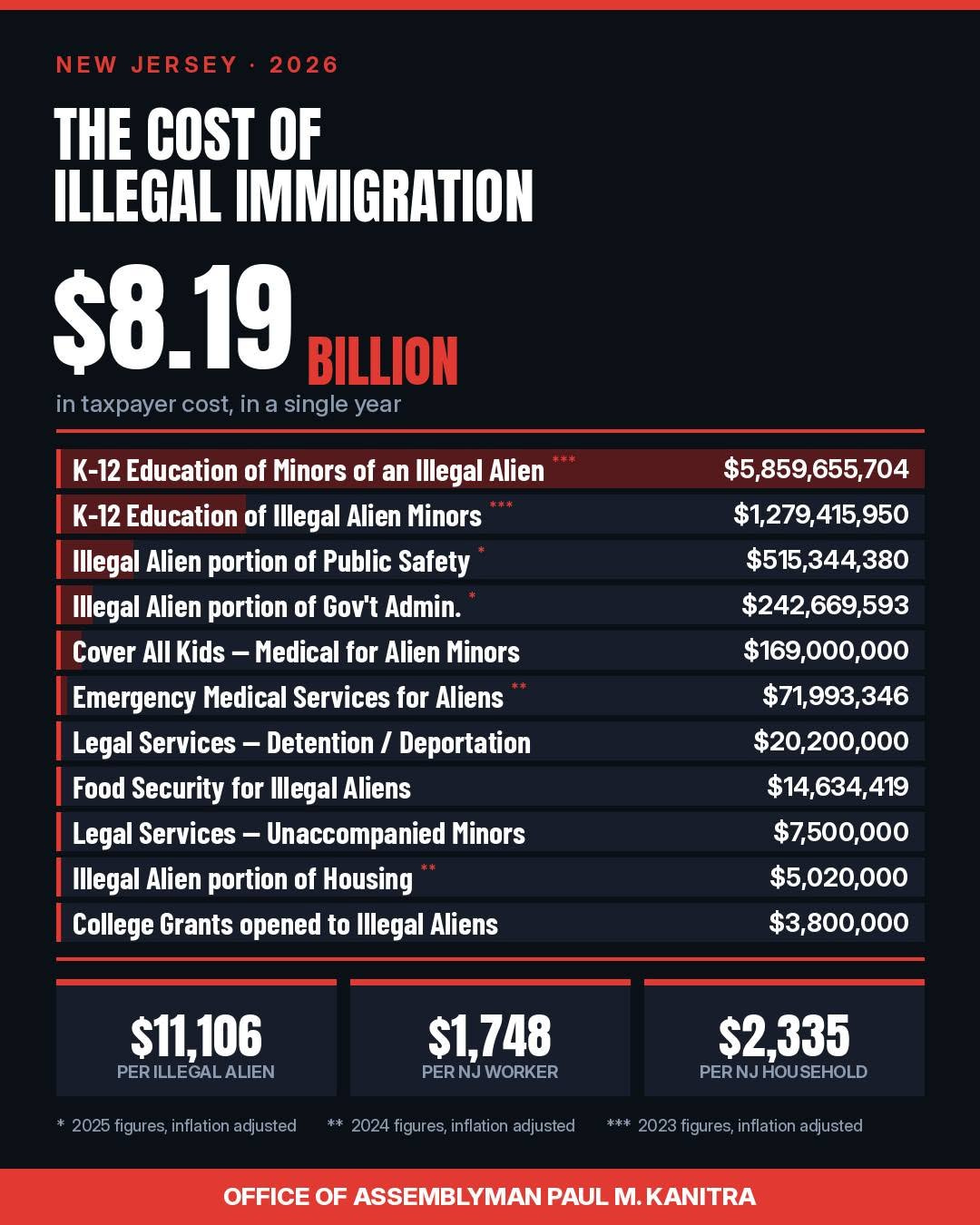
$8.2 billion. That is what the report estimates New Jersey’s state and local governments now spend annually in connection with the roughly 737,000 illegal aliens living in this state.
Spread across New Jersey’s workforce, that works out to $1,747 per worker, per year. Per household, $2,333. Per illegal alien present in the state, $11,099.
Those are numbers no one was asked to approve, attached to programs most residents have never seen itemized.
Fewer people. Bigger bill.
The finding that should reframe this debate isn’t the headline figure. It’s in the population math underneath it.
Kanitra’s office starts from the Federation for American Immigration Reform’s baseline of 815,900 illegal aliens in New Jersey. It then subtracts an estimated 109,750 — New Jersey’s proportional share of the 2.5 million people the Department of Homeland Security says have been deported or have self-deported since President Trump returned to office. It adds back roughly 31,000 for net interstate migration, since Census data show a 50 percent increase in non-citizens relocating to New Jersey from other states compared with the 2010s.
The result is 737,000, against a state population of about 9.6 million — 7.68 percent, or nearly one in thirteen people in New Jersey.
Note the shape of that calculation. The illegal alien population in New Jersey is smaller than it was two years ago. Apprehensions at the southern border collapsed in early 2025 and have stayed down. Federal enforcement is working, and it is working here.
The bill still went up.
That undercuts the argument Trenton has relied on since 2021 — that New Jersey is a passive recipient of Washington’s failure, absorbing costs it never chose and cannot control. If that were the whole story, spending would be falling alongside the population. It isn’t. Which suggests the border is no longer the variable driving the number.
Trenton is.
A map they never expected to see printed.
The most consequential material in this report isn’t an estimate. It’s a records request.
Through the Office of Legislative Services, Kanitra’s office obtained Motor Vehicle Commission data on affidavits filed under the 2019 law Governor Murphy signed in lame duck — the law allowing an applicant who can produce neither a Social Security number nor an ITIN to obtain a standard New Jersey driver’s license by signing a form instead.
More than 100,000 of those affidavits have been filed.
Then the office did something nobody else has. The MVC supplied raw ZIP codes; staff assigned each one to a municipality and legislative district and mapped the result.
Jersey City: 12,837
Newark: 8,306
Paterson: 4,510
Elizabeth: 4,211
West New York: 3,781
Twenty-eight municipalities clear a thousand licenses apiece, and those twenty-eight account for 65.4 percent of the statewide total. Hudson County alone holds roughly 280 percent more affidavit licenses than its share of New Jersey’s adult citizen population would predict.
Sorted by legislative district, the concentration is sharper still. Districts 33 and 31 — each represented top to bottom by Democrats — hold 17.9 percent of every affidavit license in New Jersey while containing 5.10 percent of the state’s population.
The report is careful about what this does and does not establish. Issuing a license is not itself a taxpayer expense, and not a dollar of it appears in the $8.2 billion. It doesn’t need to. What the map supplies is the geography of the rest of the bill — and a record of which districts have generated it while their legislators voted to keep the pathway open.
Worth noting: New Jersey law makes these affidavit records nearly impossible to verify independently. Kanitra’s office recommends the federal government pursue any lawful means available to obtain them. Given that the United States is currently suing New Jersey over multiple provisions of its immigration regime, that recommendation may not remain hypothetical.
Now we’re paying their lawyers.
For the clearest illustration of the report’s central claim — that this spending is chosen rather than imposed — look at what New Jersey now spends defending illegal aliens against deportation.
In 2018, the newly seated Democratic trifecta created the Detention and Deportation Defense Initiative to provide free legal counsel to aliens in federal removal proceedings. The initial appropriation was $2.1 million, rising to $2.8 million the following year. A parallel program, Kids In Need of Defense, followed in 2021, along with a separate budget line for legal services to unaccompanied minors. Kanitra’s office confirmed the full appropriation history through OPRA requests to the Department of Human Services. These are not modeled estimates; they are enacted line items.
Then came June, and things were certainly busting out all over.
With the state in a budget crunch and Newark’s Delaney Hall detention facility surrounded by nearly two weeks of clashes between demonstrators and federal agents — clashes serious enough that New Jersey State Police were deployed alongside their federal counterparts — Governor Mikie Sherrill announced on social media that she was increasing DDDI funding “by $12 million – for a total of $20.2 million.” She paired it with a new Rapid Legal Response Initiative to expand emergency immigration defense capacity statewide, describing the package as a matter of due process and the human rights of detainees and their families.
With the Legislature’s increase to KIND, 2026 taxpayer funding for the legal defense of aliens facing deportation reaches roughly $26.1 million — more than 830 percent above the original appropriation in eight years, adjusted for inflation.
It’s worth being precise about what this program is and isn’t. It is not emergency room care that federal law requires a hospital to provide. It is not a classroom seat the Supreme Court has held a state may not deny. It is state funding for attorneys whose professional objective is to defeat the enforcement of federal immigration law — the same law the federal government is presently suing New Jersey over. Whatever one thinks of the underlying policy, it is a discretionary expenditure, made deliberately, in a year when the state pleaded poverty on other priorities.
There is a second layer. Separately from the money paying aliens’ counsel, the state pays its own. Kanitra’s office asked OLS to price what New Jersey has spent defending its sanctuary-style laws in court. OLS identified ten lawsuits since 2018 — litigation over the ICE detention facility ban, the non-cooperation and sanctuary policies, and multiple 2026 suits brought by the federal government — involving nineteen attorneys of record, including Solicitor General Jeremy Feigenbaum. The maximum estimated cost came to roughly $4.3 million, and OLS cautioned the figure overstates the case because it charges each attorney’s full annual salary against the litigation.

What the money actually buys.
The rest of the ledger, in order of size.
Education: $7.14 billion. By a wide margin the largest category, roughly 87 percent of the total. About $1.28 billion educates an estimated 41,000 illegal alien minors at New Jersey’s average per-pupil expenditure of $29,978. The remaining $5.86 billion covers an estimated 188,000 school-age U.S.-born children of illegal alien parents — the same accounting method used by FAIR and the Congressional Budget Office, on the reasoning that those children are enrolled in New Jersey schools because a parent entered unlawfully. Both figures exclude English language instruction, bilingual programming and translation services, which means the real number is higher. This is also the one category genuinely imposed on the state: Plyler v. Doe was decided five to four in 1982, and several states are now positioning to test whether it still commands a majority.
Public safety and essential services: $515 million. The population-based share of police, fire, corrections, sewer and sanitation spending.
General government administration: $243 million. The share of courts, financial administration and recordkeeping.
Cover All Kids: $169 million. When Governor Murphy expanded NJ FamilyCare to children regardless of immigration status, the projection was 16,000 enrollees at roughly $66.5 million annually — about $88.4 million in today’s dollars. Actual enrollment by FY2025 exceeded 44,000 children, nearly triple the estimate, and OLS now puts annual spending above $169 million, roughly double the original projection. Bill A1357, pending in the Legislature, would extend comprehensive coverage to undocumented adults at an OLS-estimated cost of at least $684 million a year.
Emergency medical care: $72 million. New Jersey drew a record $67.4 million in federal Emergency Medicaid for services to illegal aliens in 2024 — about $72 million in 2026 dollars, 121 percent above the Obama-era average and 139 percent above President Trump’s first-term average. The 2024 edition of this report predicted the surge would produce record medical expenditures. The CMS data confirmed it.
Food security: $14.6 million. The illegal-alien share of state-funded food programs, derived from CIS findings on SNAP utilization. Federal benefit payments are excluded.
Housing assistance: $5.02 million. Continuum of Care dollars reaching mixed-status households, where a subsidy is prorated to eligible members — typically U.S.-born children — while the family, including the ineligible parent, occupies the unit.
College financial aid: $3.8 million. The documented 2019 figure for aid to 749 illegal alien students under the 2018 law. HESAA hasn’t published an update since, so the report uses the seven-year-old number rather than projecting forward.
The costs Trenton didn’t have to choose.
Set those categories side by side and a pattern emerges.
Roughly $7.14 billion of this bill flows from federal mandates New Jersey didn’t write — Plyler for the classrooms, EMTALA for the emergency rooms. Reasonable people disagree about both, and that argument belongs in Washington and at the Supreme Court.
The remainder was chosen. The health coverage expansion, the deportation defense fund, the food programs, the tuition aid, the license law that made the map possible — each was passed in Trenton, signed in Trenton, and expanded in Trenton.
The growth rates are where it gets interesting. The discretionary programs are the ones compounding fastest: legal defense up 830 percent, Cover All Kids up 417 percent since 2022, affidavit driver’s licenses up 205 percent in four years, emergency medical spending up 154 percent. The category no one in Trenton controls — K-12 education — grew 53 percent over a comparable stretch.
Mandated costs are drifting upward at something close to the rate of inflation and enrollment. Discretionary costs are compounding at multiples of it. That is not the profile of a state overwhelmed by forces outside its control. It’s the profile of a state whose governing coalition has decided this is what the money is for.
Read the caveats. Then read them again.
The predictable response will be to attack the methodology. Anyone who does should have to account for what the report declined to count.
A March 2026 Federal Reserve Bank of Dallas study — the first to estimate the causal effect of unauthorized immigration on local housing markets using administrative microdata — found that unauthorized worker inflows drove roughly 30 percent of house-price growth and 20 percent of rent growth during the 2021–2024 boom, with the New York metropolitan region absorbing the largest inflows in the country. Applied to New Jersey’s metro areas, that translates to between $4,770 and $28,370 added to the price of a typical home, and $24 to $79 a month added to a typical rent. For a young couple trying to buy a first house in this state, that is not an abstraction.
None of it appears in the $8.2 billion. It isn’t a government expenditure, so it wasn’t counted.
Neither is the $4.3 million in sanctuary-law litigation defense. Neither are ELL and bilingual costs. The college aid figure is seven years stale and used anyway. The housing estimate assumes illegal alien households use homelessness services at the same rate as the general population, which the report concedes likely understates it. And the report declines to net out the roughly $1.33 billion in state and local taxes ITEP estimates illegal aliens pay — while noting that even accepted at face value, that sum offsets about 16 percent of the total.
A document engineered to inflate a number doesn’t repeatedly leave money on the table. This one does it in at least four places.
Fifteen bills. No destination - yet.
The report closes with legislation: fifteen bills where Kanitra is a prime sponsor and ten more he supports. The Immigration Enforcement Support Act (A322), authorizing local police to detain and transfer illegal aliens to federal custody. The Public Charge Transparency Act (A330), requiring agencies to record and report the cost of assistance provided to illegal aliens. The Illegal Alien Healthcare Transparency Act (A308). Mandatory E-Verify in public contracts (A2959). Repeal of the codified Immigrant Trust Directive (A5176).
None of them are likely to advance — not in a Legislature that recently passed a sanctuary statehood bill and established a state portal for reporting the conduct of federal agents.
Kanitra knows that. Publishing the number is the point.
So ask the question the architects of these programs have never once been made to answer on the record. Not the projection — the projections were wrong by a factor of three on Cover All Kids alone. The ceiling. At what number does a state that leads the nation in property taxes, that cannot fund its own transit system, that has watched its own residents pack up for cheaper states, decide it has finally spent enough underwriting people the federal government is actively working to remove?
Nobody in Trenton is going to answer that. Not because the question is unfair it’s because there isn’t an answer.
There has never been a ceiling — only the next appropriation, and the next one after that, and a working assumption that the people footing the bill would never see it itemized. That the property tax conversation and the immigration conversation would stay in separate rooms indefinitely.
They are in the same room now. Thirty-nine pages, 108 footnotes, drawn largely from the state’s own records.
$8.2 billion. $2,333 per household. $1,747 per worker. Nearly one in thirteen.
The invoice is now here. The people who ran it up have names, districts, and voting records. Use them wisely.
The 2026 Report on the Cost of Illegal Aliens to New Jerseyans was prepared by Assemblyman Paul M. Kanitra and Policy Director Todd Lund Jr., 10th Legislative District Office, 852 Highway 70, Brick, NJ 08724.
Want more CJN? Make sure to follow us on our respective social media platforms. If you’re interested in joining the team, have questions about advertising, or want to send us a note, message us here on Substack.